

A controlled path from canon source to production handoff.
Studio checks new narrative work against governed sources, shows the evidence behind each finding, and keeps the reviewed human decision with the change.
Guarded source of truth—with citations, corpus boundaries, and narrative owners in control.
Additive adoption
Keep the tools your team already knows.
The first engagement does not require an authoring migration or a new task system. Studio can begin with exported or connected project sources and return findings for review. A deeper workflow is introduced only after the audit proves where it helps.
First engagement
- One agreed corpus and authority model
- No replacement of the wiki or production tracker
- Defined data flow, retention, export, and deletion
- A report that remains useful even if you stop
Product proof
The Studio surface is real—and built for narrative work.
These captures come from the running Studio product on its Shattered Realm demonstration world, not a marketing reconstruction.
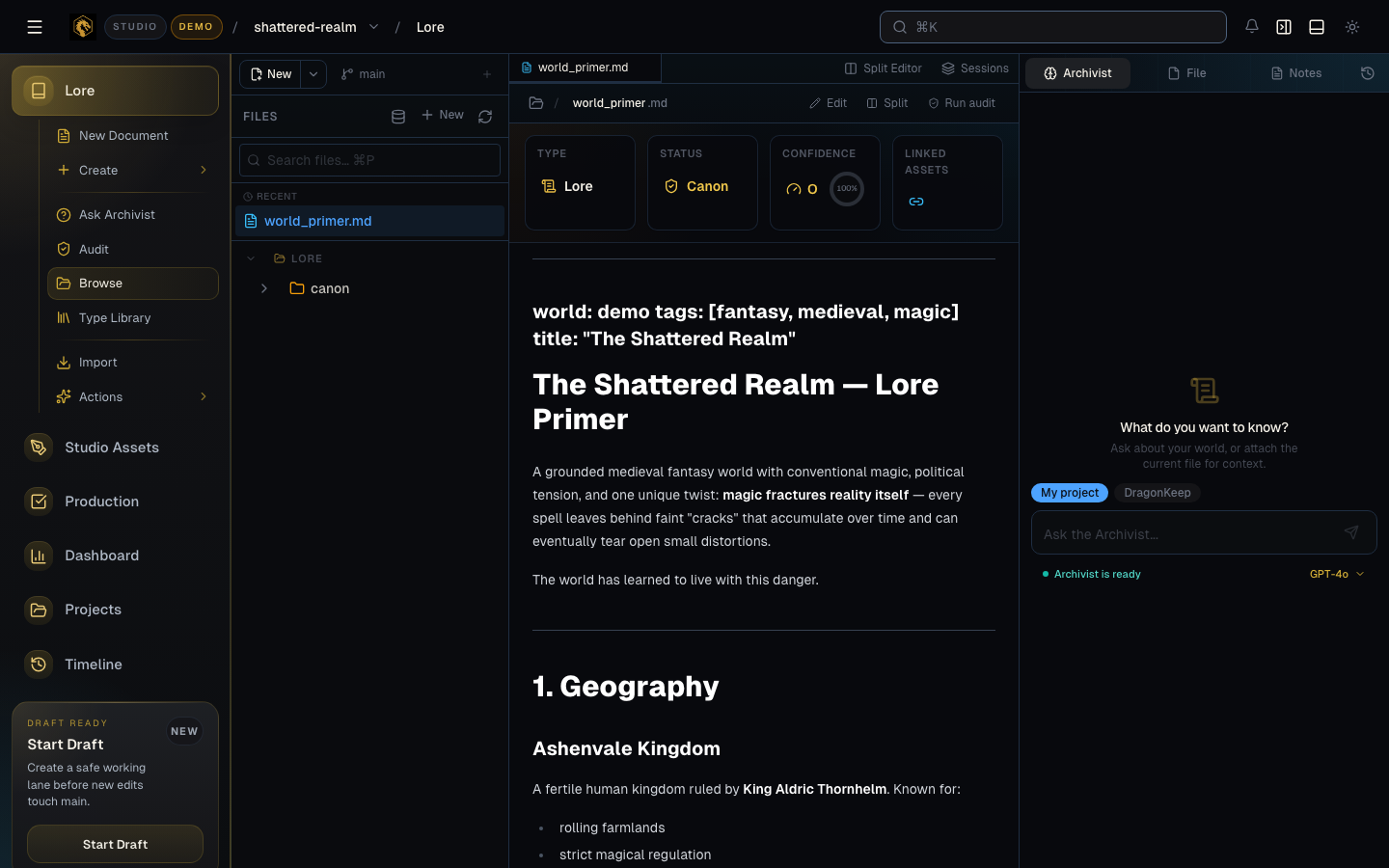
Lore workspace
Governed canon and cited recall in one review surface.
Canon, legends, and sandbox tiers stay visibly separated. Writers open a governed file with its type, canon status, and confidence, run an audit from the same surface, or ask the Archivist with the file as context.
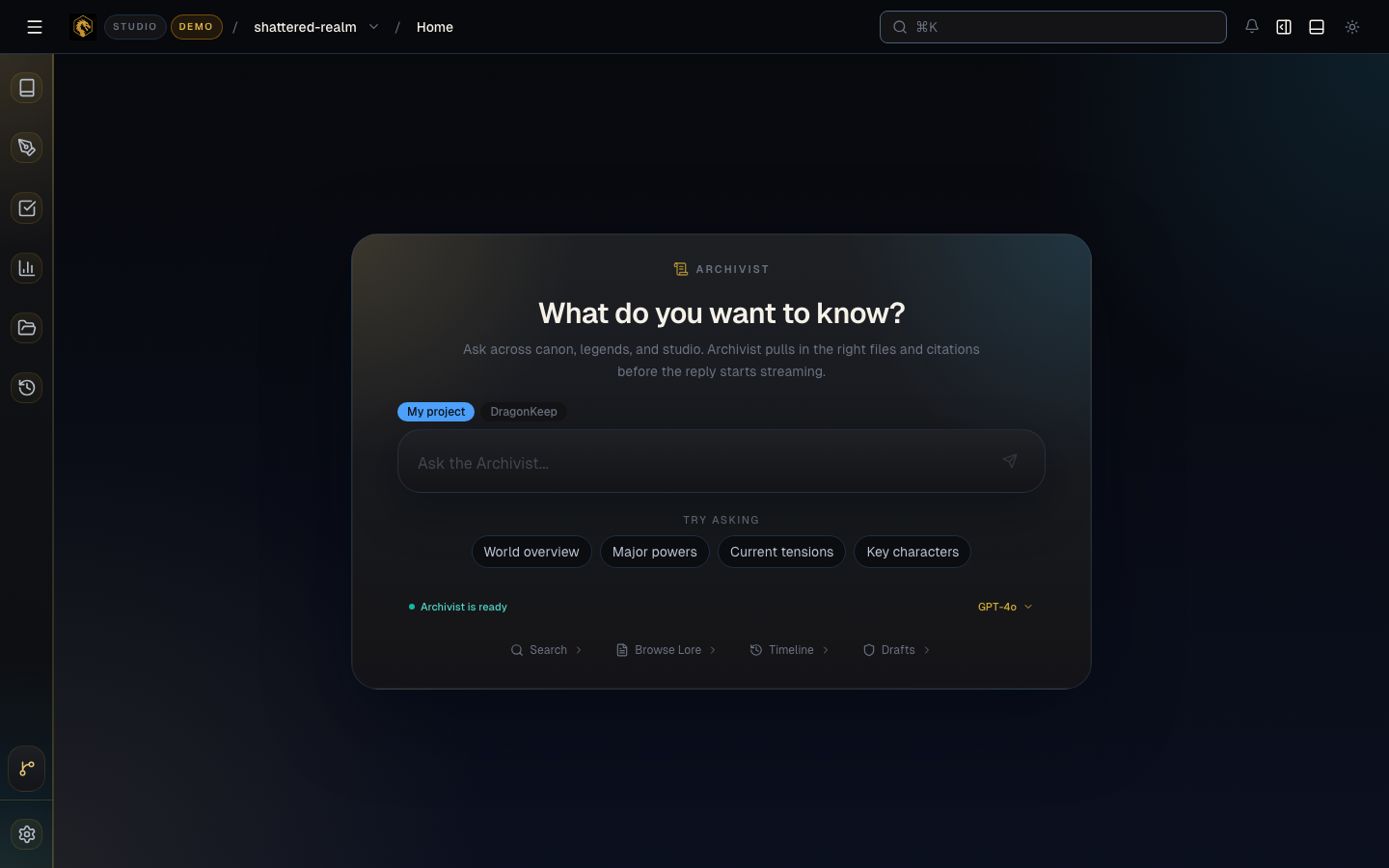
Ask surface
Every answer starts from your governed sources.
The Archivist answers from the project corpus with citations, pulling the right files before the reply starts. Search, lore browsing, timeline, and drafts are one step away.
Studio workflow
Check, decide, preserve, hand off.
Start with the existing corpus
Bring agreed bibles, scripts, quest documents, wiki exports, and reference files. The audit begins as a read-only review layer.
Ask canon with citations
Query governed sources, open the supporting passages, and see when those sources disagree rather than receiving a confident blend.
Check narrative work
Run a file, draft, or bounded project check while quests, dialogue, scenes, and scripts are still reviewable.
Resolve as the owner
Correct, accept, suppress, or record an exception. A finding presents evidence; it does not overrule creative authority.
Keep governed history
Carry the resolution into the diff, ChangeSet, checkpoint, and approval history instead of losing the reason in chat.
Create a clean handoff
Export the agreed, cited package for review, localization, co-development, or the next team inheriting the world.
Human authority
Verification, not generation.
DragonKeep does not act as an autonomous writer or canon authority. It makes source support and disagreement inspectable, then records what the responsible human decides.
AI-assisted changes enter the same reviewable, revertible ChangeSet path as other proposed edits.
- 1. Surface: DragonKeep presents a supported conflict and its corpus context.
- 2. Inspect: The narrative owner opens the relevant sources.
- 3. Decide: The owner corrects, accepts, suppresses, or records an exception.
- 4. Preserve: The evidence and resolution remain in history.
What a pilot measures
Prove value in one production slice.
Turn one person’s memory into cited, reviewable project memory the team can share.
Make continuity risk visible while narrative work is still cheap to change.
Preserve why a decision was made through team change, handoff, and downstream review.
Measure lookup time, review effort, and downstream rework in a bounded pilot instead of promising universal ROI.
Begin with your material, not a migration plan.
The $500 design partner pilot opens with a canon-risk audit, is credited in full toward your first annual license, and comes with a real stop option.